
How to Choose the Right Vibration Isolator for Your Industrial Equipment?
How to Choose the Right Vibration Isolator for Your Industrial Equipment?
Introduction
Every industrial machine creates vibrations during its operation. If these vibrations are not controlled, they can cause early damage, poor performance, extra maintenance costs, and even safety risks. To solve this, industries use vibration isolators.
A vibration isolator helps reduce the amount of vibration that passes from the machine to its base or surrounding structure. Choosing the right one is very important for the life, safety, and efficiency of your equipment.
In this blog, we will explain why vibration isolators matter, key factors to consider before choosing, and some reliable product options.
Why Vibration Isolation Is Important
If a machine vibrates without proper isolation, it can lead to:
- Faster wear and tear of machine parts
- Adversely affects material flow, measurement accuracy (sensors, weighing machines), and product consistency
- Operational disruptions due to repeated breakdowns and high maintenance costs
- Noise and safety issues in the working environment.
By using the right isolator, you can keep your machines stable, safe, and long-lasting.
Types of Vibration isolators that are commonly used in diverse industrial applications
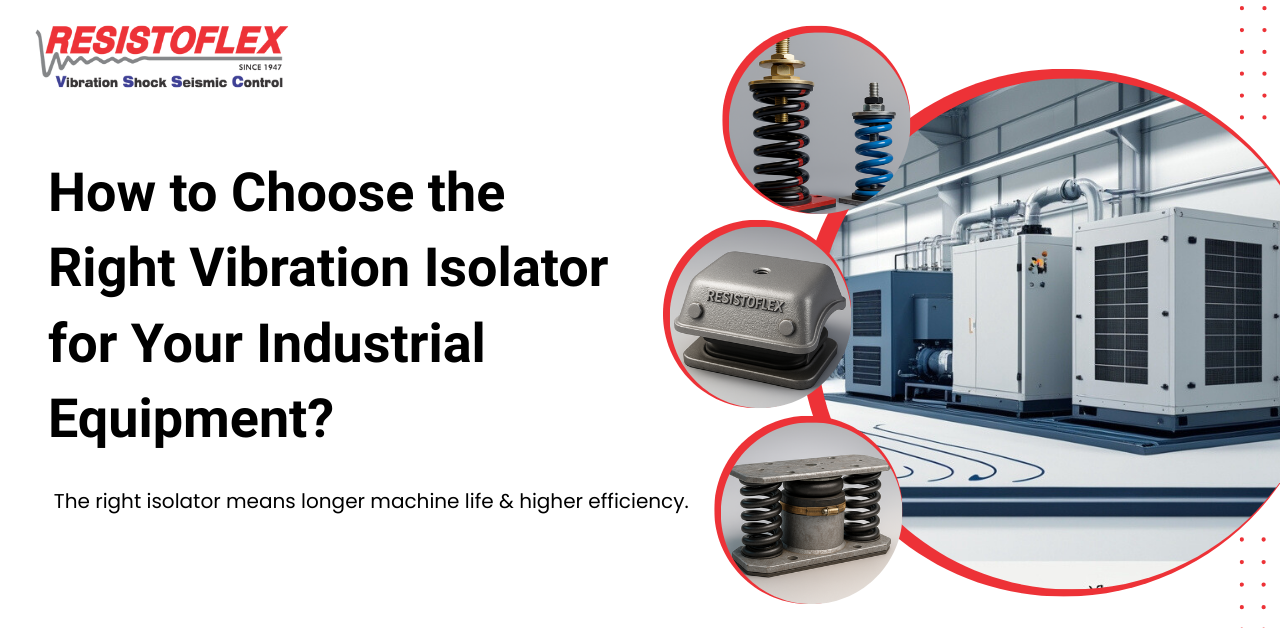
To control unwanted vibrations in machines, the right isolator is essential. These isolators work without external power, relying on stiffness, damping, and mass. They are simple, reliable, and widely used.
- Elastomeric Mounts (Rubber Pads)
- Made of rubber, neoprene, or silicone.
- Cost-effective, flexible, and ideal for small to medium machines.
- Spring Isolators
- Helical steel springs, often with damping pads.
- Great for low-frequency isolation in HVAC, turbines, and compressors.
- Cork or Felt Pads
- Lightweight and inexpensive.
- Suitable for light equipment, but limited in performance.
- Wire Rope Isolators
- Stainless steel cables between bars.
- Rugged, corrosion-resistant; used in military, aerospace, marine.
- Spring Viscous Damper System:
- Combines springs and viscous damping to handle complex vibration issues.
- It is ideal for critical applications requiring precise vibration control.
- Hangers
- Designed to isolate vibrations in suspended equipment such as fans, AHU, Ducts, and VRF in HVAC systems.
Key Points to Consider Before Selecting the Right Isolator
1. Load Capacity
- Calcul style="margin-left: 22px;"ate the total weight of your machine (including moving loads).
- Ensure the isolator can handle this load evenly across all mounting points.
3. Working Environment
- If your factory has heat, moisture, oil, or chemicals, choose isolators made from anti -corrosion and resistant materials.
- For industries like pharma or food processing, isolators shoul style="margin-left: 22px;"d meet good cleaning and safety standards.
4. Space and Installation
- Check the space available under and around the machine.
- Some isolators (like spring or air isolators) need more space than rubber mounts depending upon the applications.
- Ensure the design fits your machine's base and mounting holes.
5. Analysing Long-Term Cost
- Elastomeric isolators offer an economical solution with straightforward installation and moderate service life.
- Spring and metallic isolators ensure extended operational reliability under heavy load conditions.
- Evaluation of upfront investment vs. lifecycle performance is essential for cost optimization.
Step-by-Step Guide to Selecting the Right Isolator
- Understand your machine specs – weight, size, and speed.
- Find the vibration level – from manufacturer data or sensors.
- Match load, frequency, and environment with the isolator design.
- Plan installation – ensure proper space and secure mounting.
- Review long-term durability and maintenance needs.
- Consul style="margin-left: 22px;"t experts or suppliers before final purchase.
Resistoflex - Reliable Vibration Isolators You Can Trust
If you are looking for proven solutions, Resistoflex offers a wide range of anti-vibration mounts that have been trusted across industries for over 70 years. Some notable products include:
- Fleximount Rubber Isolator – Compact, reliable, ideal for engines and compressors.
- Genflex Rubber Mount – Strong elastomeric mount, perfect for pumps, DG sets, and HVAC systems.
- Open Spring Damper & Seismic Spring Mounts – Designed for heavy machinery and seismic safety.
- Coniflex & Equiflex Mounts – Provide efficient vibration absorption in compact spaces.
- Mobiflex Mount – Oil-resistant, corrosion-protected; great for marine or mobile applications.
- Cup Mounts – Effective for high-impact shocks and mid-to-high frequency vibrations.
These isolators are tested, certified, and widely used in industries like power generation, railways, defense, marine, HVAC, and manufacturing.
Conclusion
The right vibration isolator is not just an accessory—it is a Foundational investment for your machine's performance and safety.
By checking load capacity, machine frequency, environment, space, and long-term cost, you can confidently select the isolator that fits your equipment best.
Whether it's a rubber mount, spring isolator, pneumatic system, or advanced active isolator, the key is to match it with your machine's requirements.
👉 With trusted solutions from companies like Resistoflex, industries can ensure smoother operations, lower maintenance costs, and longer equipment life.